Why AI Needs Forward Deployed Consultants, Not Just Forward Deployed Engineers
The Forward Deployed Engineer model has gained traction because complex AI projects need technical experts who work directly with customers to build value quickly. But as enterprises move from experimentation to transforming core functions, technical skill alone falls short: the deciding factor is context, which is usually what's missing.
Date
June 9, 2026
Topic
Agentic AI
Share
The AI industry has become increasingly fascinated with the concept of the Forward Deployed Engineer (FDE). And for good reason because as AI projects become more complex, organizations need technical experts who can work directly with customers, understand their environments, and rapidly build solutions that create value. Forward Deployed Engineers bridge the gap between engineering and implementation, helping organizations move faster than traditional software delivery models.
While this model works on the surface, there’s an underlying challenge. As enterprises move beyond experimentation and begin transforming core business functions with AI, technical expertise alone is no longer enough. The reality is that AI initiatives succeed or fail based on one critical factor - context, which is often the missing ingredient.
The Industry's Focus on Forward Deployed Engineers
The rise of AI has created enormous demand for engineers who can operate close to customers. Organizations need people who can:
Understand complex technical environments
Integrate with existing systems
Build and deploy AI solutions quickly
Iterate based on customer feedback
Forward Deployed Engineers excel at these tasks because they bring technical depth, accelerate implementation, and help customers realize value faster than traditional consulting models. The challenge is that building a technically sound solution does not automatically guarantee business value. A solution can be elegant, scalable, and technically impressive but still fail to solve the right problem.
Why Business Context Matters
Consider a manufacturer looking to improve operational efficiency. An engineer might identify opportunities to automate reporting, summarize production data, or create predictive models. All of these are valid use cases but may not be the most valuable. Perhaps the organization is struggling with unplanned downtime, or perhaps inventory management is creating supply chain bottlenecks, or quality defects are driving significant revenue leakage.
Without understanding the business context, it's difficult to distinguish between an interesting AI application and a transformative one that can deliver meaningful value. This becomes even more important in the age of Agentic AI.
Modern AI systems are no longer simple chat interfaces. They influence decisions, automate workflows, orchestrate processes, and interact with customers and employees.
To design these systems effectively, teams need to understand:
Business objectives
Organizational priorities
Process constraints
Change management considerations
Regulatory requirements
Success metrics
These are business questions that require an intimate understanding of how businesses operate and how to prioritize value over vanity.
The Rise of the Forward Deployed Consultant
This is where we believe the industry needs an additional role: the Forward Deployed Consultant (FDC). An FDC operates alongside engineers but approaches problems from a different perspective. Their primary responsibility is understanding the business and they work closely with executives, business stakeholders, operations teams, and end users to answer questions such as:
What problem are we trying to solve?
What outcomes matter most?
How should success be measured?
Which use cases create the greatest value?
What organizational barriers could prevent adoption?
The FDC provides the context that transforms AI from a technology initiative into a business transformation initiative.
Better Together: FDCs and FDEs
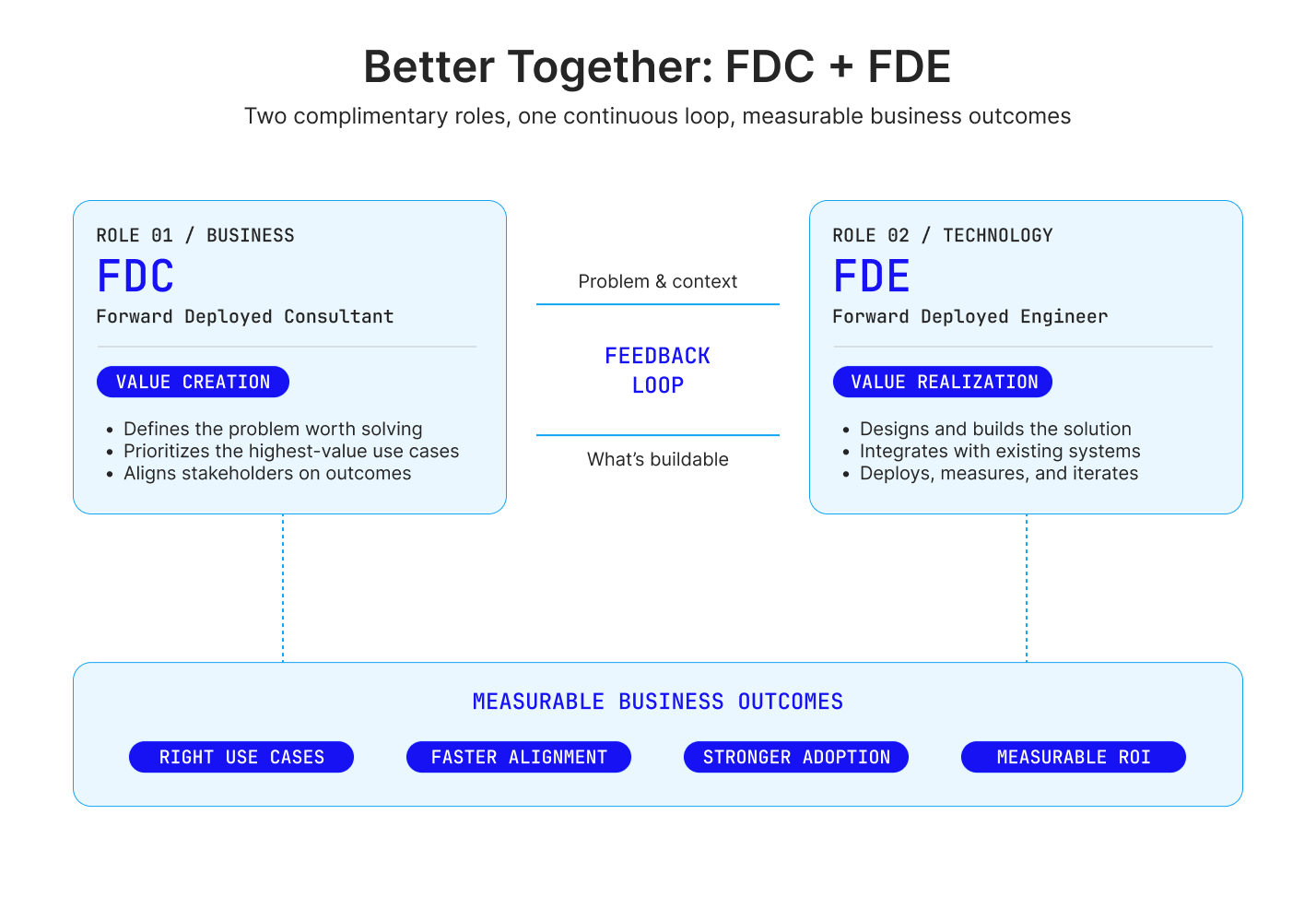
At Soul of the Machine, we believe the strongest AI teams combine both Forward Deployed Consultants and Forward Deployed Engineers. The FDC helps define the problem, prioritize opportunities, and align stakeholders around business outcomes. The FDE designs, builds, integrates, and deploys the technical solution. One focuses on value creation while the other focuses on value realization. Together they create a feedback loop that continuously improves both the business strategy and the technical implementation.
Better together: FDC + FDE
This approach delivers several benefits:
1. Better Use Case Selection: Teams focus on solving the highest-value business problems rather than the most technically interesting ones.
2. Faster Executive Alignment: Business stakeholders see a direct connection between AI initiatives and strategic objectives.
3. Improved Adoption: Solutions are designed with users, processes, and change management in mind from day one.
4. Measurable ROI: Success metrics are defined before implementation begins, making value easier to track and communicate.
5. Reduced Delivery Risk: Business and technical considerations are addressed simultaneously rather than sequentially.
AI Transformation Is a Team Sport
As AI becomes increasingly embedded in enterprise operations, organizations need more people who understand how businesses operate. They need people who can connect strategy to execution and people who can translate business problems into technical solutions and technical capabilities into business outcomes.
The fastest way to fail an AI initiative is to build the wrong thing efficiently. That is why we believe the future belongs not just to Forward Deployed Engineers, but to teams that combine Forward Deployed Consultants and Forward Deployed Engineers working together. Because AI transformation is not ultimately about technology. It's about solving meaningful business problems and delivering measurable outcomes. And that usually starts with context.