AI Strategy
Why Most AI Projects Fail Before They Ever Start
Artificial Intelligence has quickly moved from experimentation to boardroom priority. Executives are being asked about AI strategy during earnings calls. Boards want to understand how AI will impact competitiveness and business leaders are under pressure to identify opportunities, improve productivity, and create new sources of value.
Yet despite the excitement, many organizations struggle to move beyond isolated pilots and proof-of-concepts. In our view, the problem is that most AI initiatives fail before the first agent is deployed, and even before the first line of code is written. The seeds of failure are often planted at the very beginning.
The AI Gold Rush
Over the last two years, organizations have been inundated with AI possibilities. Every vendor (including us) promises transformation and every conference highlights breakthrough use cases. Several teams have ideas for how AI can improve their function. But the result is often a flood of enthusiasm combined with very little structure.
Leadership teams quickly find themselves asking:
Which use cases should we prioritize?
What business outcomes are we trying to achieve?
How do we measure success?
Is our data ready?
Who owns the initiative?
How do we scale beyond a pilot?
Without clear answers, organizations often default to experimentation. And while experimentation is valuable, experimentation without direction creates what many organizations eventually experience: pilot purgatory.
The Pilot Purgatory Problem
We’ve seen many companies doing dozens of AI experiments. Typically it is a chatbot, a summarization tool, an internal copilot etc. While individually these initiatives may demonstrate promise, collectively, they often fail to create meaningful business impact.
The most common reason that we’ve seen is that they were selected based on what is technically possible rather than what is strategically important.
The question should never be:
What can we build with AI?
The question should be:
What business problem are we trying to solve?
The distinction may seem subtle, but it changes everything.
The Five Reasons AI Projects Fail Before They Start
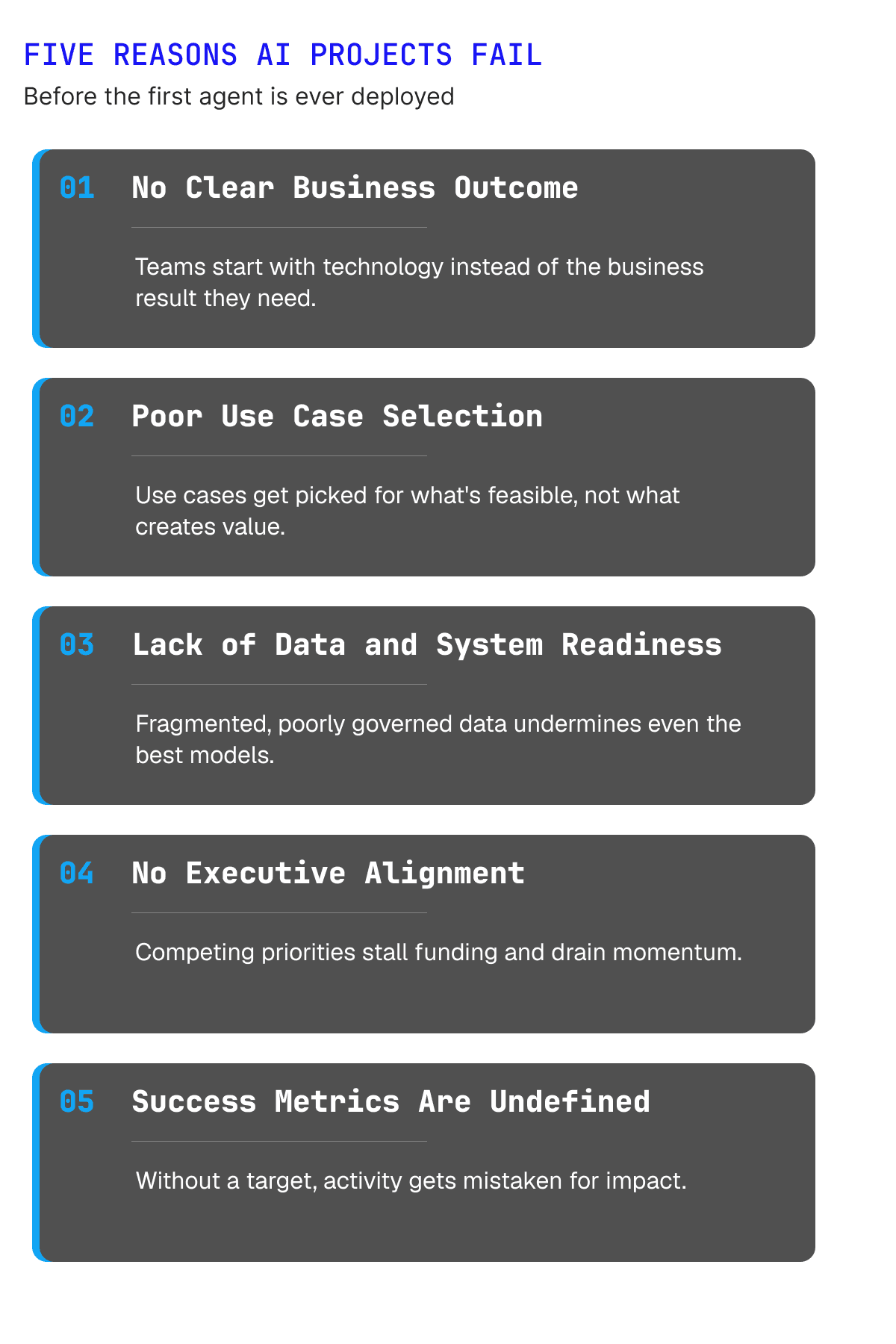
1. No Clear Business Outcome
Many organizations begin with technology and work backwards. We advise our customers to start with outcomes. Focus on the following:
Revenue growth
Cost reduction
Customer experience
Employee productivity
Risk mitigation
Operational efficiency
When the desired outcome isn't clearly defined, teams struggle to prioritize investments and measure success.
2. Poor Use Case Selection
Not every use case is worthy of investment. Some opportunities generate significant value but require years of foundational work. Others are easy to implement but deliver little impact.
The best use cases sit at the intersection of:
Business value
Technical feasibility
Organizational readiness
Data availability
Competitive differentiation
Organizations that skip this evaluation process often invest in initiatives that never justify the effort.
3. Lack of Data and System Readiness
The age old adage “Garbage in, garbage out” holds true even in the age of AI. AI is only as effective as the data and systems that support it. Unfortunately, many organizations discover too late that critical information is fragmented across systems, poorly governed, or simply unavailable.
The most successful AI programs evaluate data readiness before prioritizing use cases. They understand that the shortest path to value is often determined by the quality and accessibility of underlying data.
4. No Executive Alignment
AI touches every function within the enterprise.
Technology
Operations
Finance
Customer experience
Human resources
Product
Without alignment around priorities and expected outcomes, teams pursue competing objectives, projects stall and funding becomes difficult to secure. As a result, momentum fades and the enthusiasm that teams have starts to die down. The most successful AI transformations begin with executive consensus around where the organization is headed and why.
5. Success Metrics Are Undefined
Many organizations struggle to answer a simple question:
"How will we know if this initiative succeeded?
If success isn't defined upfront, value becomes subjective. Teams focus on activity rather than outcomes (hello tokenmaxing!!). Executives lose confidence and future investments become harder to justify. Every AI initiative should begin with measurable business objectives and a clear framework for evaluating success.
AI Success Starts Long Before Implementation
Organizations often assume that AI transformation begins when a solution is built.
In reality, transformation begins much earlier. It begins with:
Understanding your current state
Defining desired business outcomes
Assessing organizational readiness
Prioritizing use cases
Creating a roadmap
Aligning stakeholders
Only then should implementation begin. This is why leading organizations spend as much time on strategy as they do on technology. Enterprises followed these steps during the digital transformation era. Why would you skip it during the AI transformation era?
A Better Approach
At Soul of the Machine, we've found that successful AI transformations consistently follow a structured path which begins with understanding the organization's current maturity, business objectives, and constraints.
From there, leaders can identify the highest-value opportunities, prioritize initiatives based on value and feasibility, and create a roadmap that balances quick wins with long-term transformation. This approach removes much of the uncertainty that surrounds AI adoption and helps organizations focus on outcomes rather than hype.
If you're unsure where to begin, we recently explored how structured AI strategy workshops can help organizations align stakeholders, prioritize opportunities, and establish a roadmap for success. You can read more here:
Start Smart: How AI Strategy Workshops Set the Foundation for Long-Term Success
Closing Thoughts
AI has the potential to transform every industry, but technology alone doesn't create transformation. You need the right strategy and the right approach to show you the way. The organizations creating the greatest value from AI aren't necessarily the ones with the largest budgets or the most advanced models. They're the ones asking the right questions before they begin.
Because the fastest way to fail an AI initiative is to build the wrong thing efficiently. And the best way to succeed is to start with clarity.