Agentic AI
Soul of the Machine, Agent Platform: Why Agentic Systems Need an Ontology, Not Just More Context
If a chatbot misunderstands the word “account,” it may produce an irrelevant answer. If an agentic system misunderstands it, the consequences can be much larger. The agent may retrieve the wrong customer record, apply the wrong policy, call the wrong tool, or change the wrong system.
That difference is the reason ontology is becoming foundational to enterprise agent architecture.
Large language models are remarkably fluent, but enterprise operations depend on meanings that must remain stable. A customer is not the same thing as a billing account. A product is not the same thing as a SKU. “Cancel” can refer to an order, a subscription, an appointment, or an automation. The correct interpretation depends on relationships, business rules, identity, current state, and the action being considered.
Prompts alone cannot carry that burden. Retrieval-augmented generation (RAG) can supply relevant passages, but passages do not by themselves define how the business fits together. Tool schemas describe how to call an API, but not what a concept means, which system is authoritative, or when an action is appropriate.
An ontology fills that gap. It provides a shared, machine-readable model of the concepts an enterprise cares about, the language people use for them, and the relationships that connect meaning to data, policy, and action.
For agentic systems, that is not academic modeling. It is operational control.
An ontology is a contract for meaning
In practical enterprise terms, an ontology defines:
the canonical concepts, entities, intents, actions, attributes, content types, and scopes an application recognizes;
the aliases and phrases people use to refer to them;
the typed, directional relationships between them;
the enterprise sources that support each definition;
the policies and runtime uses for which each semantic object is eligible; and
the lifecycle through which meaning is reviewed, published, observed, and retired.
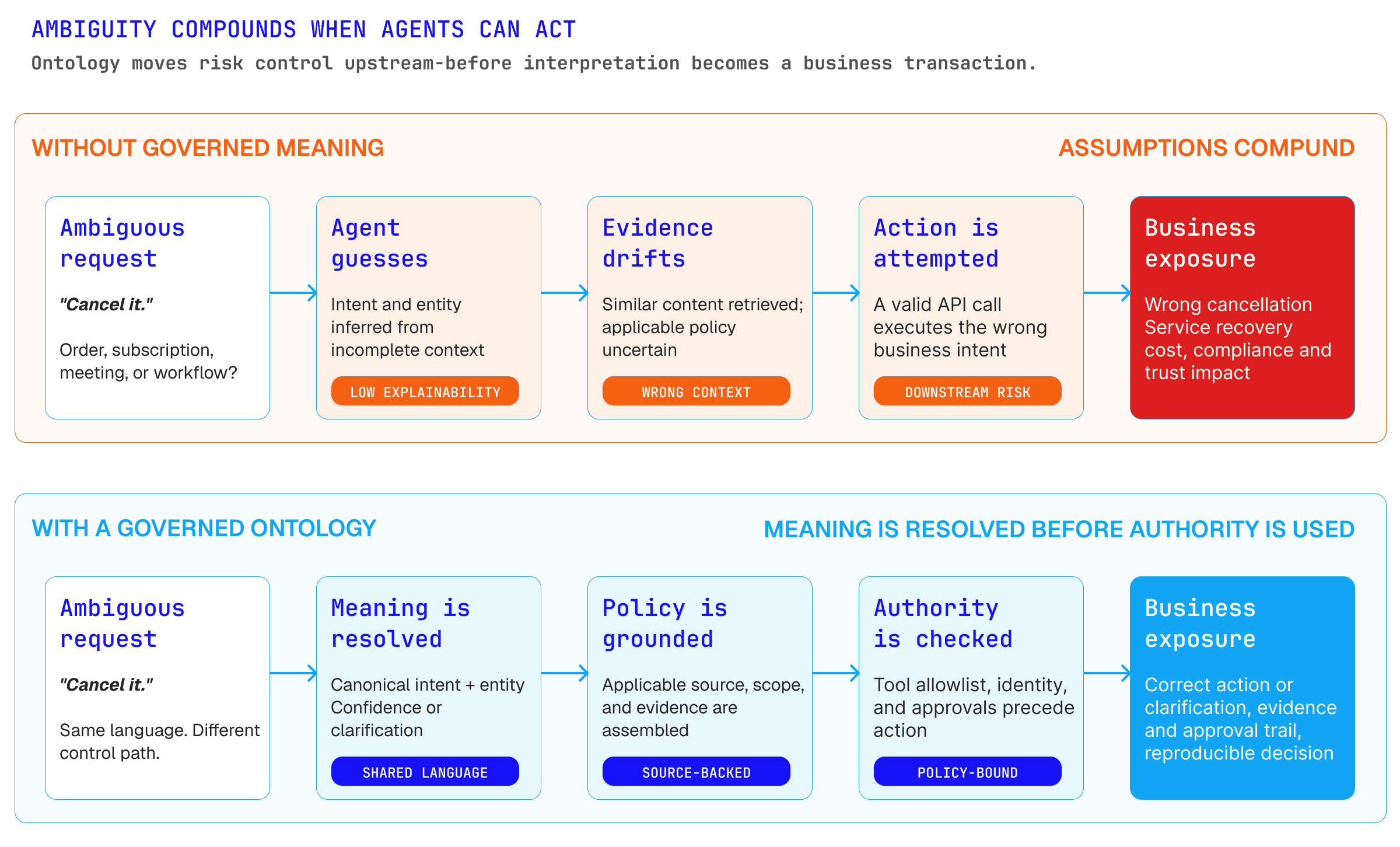
Consider a service agent handling the request, “Can I send this back and get credit?” A useful system must resolve “this” to the correct purchased item, interpret “send back” as a return intent, distinguish store credit from a refund to the original payment method, retrieve the policy that applies to that item and customer, and select an allowed action.
Similarity search helps find related words. An ontology supplies the business distinctions.
This becomes even more important as agents move beyond question answering. An agent operates in a loop: it observes, interprets, decides, acts, and evaluates the result. Ambiguity introduced at the interpretation step compounds through every later step. The more authority the agent has, the more important it is to constrain that ambiguity before action.
Why prompts, RAG, and tool schemas are not enough
Each of today’s common AI architecture patterns solves a real problem. None provides a complete meaning layer.
Prompts define behavior, not durable semantics. Domain definitions scattered across system prompts are difficult to govern, compare, and update. Two agents can receive slightly different descriptions of the same concept and behave differently.
RAG supplies evidence, not a business model. Retrieval can find a return policy or maintenance manual, but it does not inherently know that a specific item belongs to an order, that an order belongs to a customer, or that a policy applies only in a particular jurisdiction.
API schemas define call structure, not authority. A schema can say that issue_refund accepts an order ID and amount. It cannot decide whether the user means a refund, whether the order is eligible, whether approval is required, or whether the agent is allowed to act.
Vector search measures similarity, not validity. Similar terms may belong to different business domains. Conversely, two operationally related concepts may use very different language. Embeddings are powerful retrieval optimizations, but they should not become the source of truth for enterprise meaning.
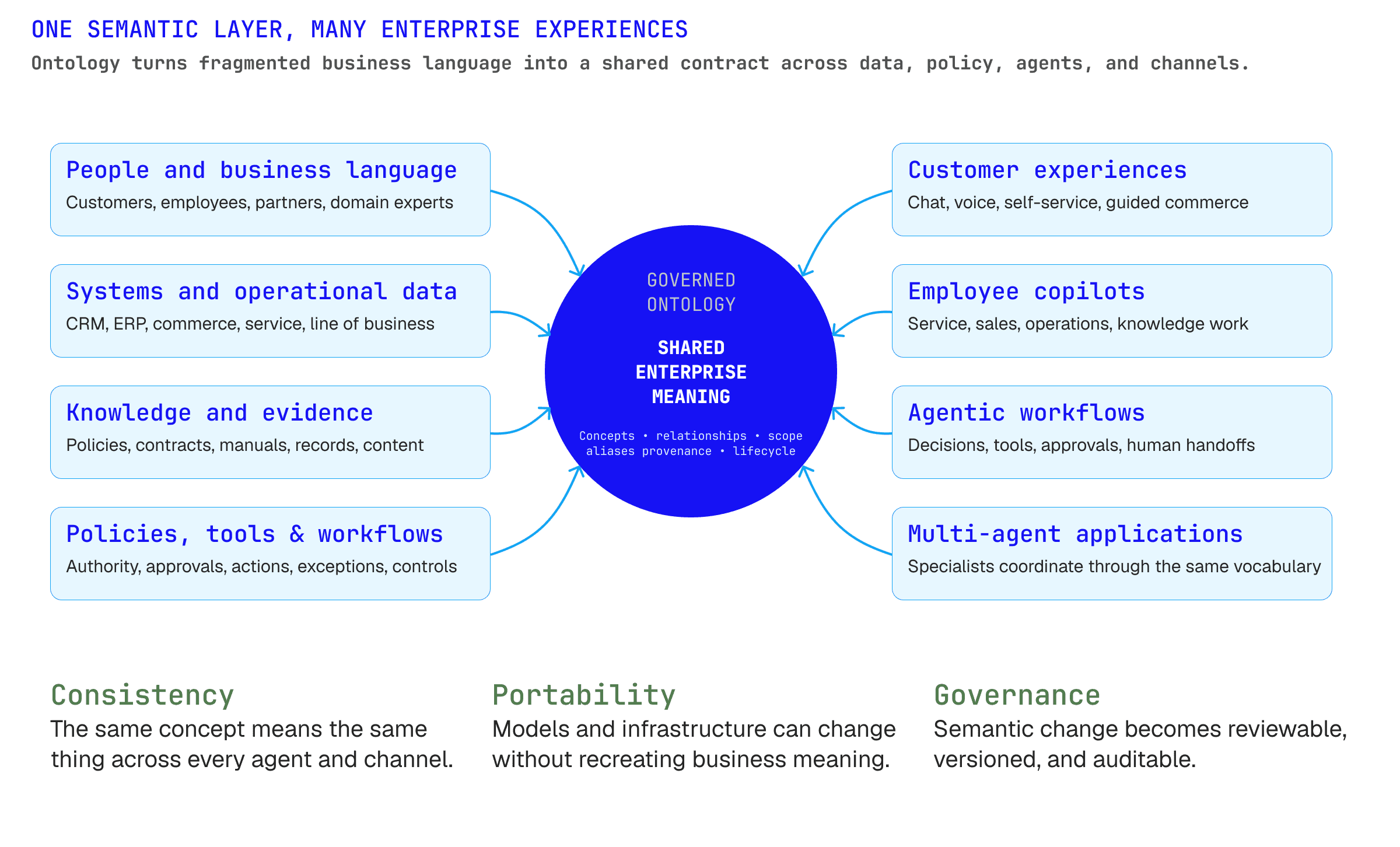
Ontology completes the stack. It gives prompts a governed vocabulary, retrieval a semantic structure, tools a business context, and agents a shared language.
The Soul of the Machine Agent Platform approach: semantic context as governed infrastructure
Soul of the Machine’s Agent Platform treats ontology as a state-of-the-art semantic control layer for each agentic application, not as a static diagram or an isolated knowledge graph.
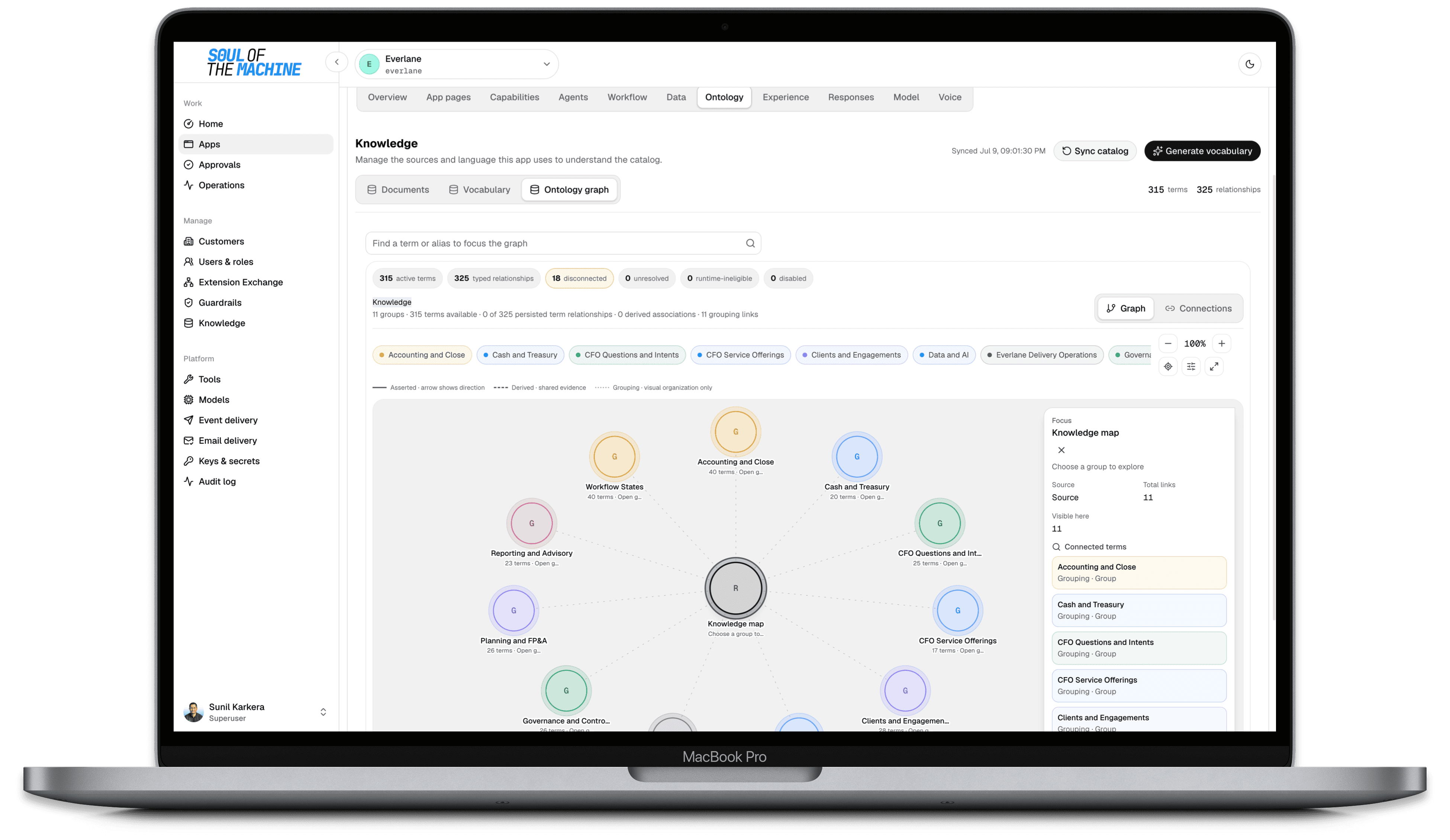
The platform compiles approved enterprise evidence into an application-scoped semantic context. That context is validated, versioned, published, pinned to runtime releases, and made available to agents through bounded runtime projections. The result is a meaning layer that can evolve with the business without becoming an invisible collection of prompt edits.
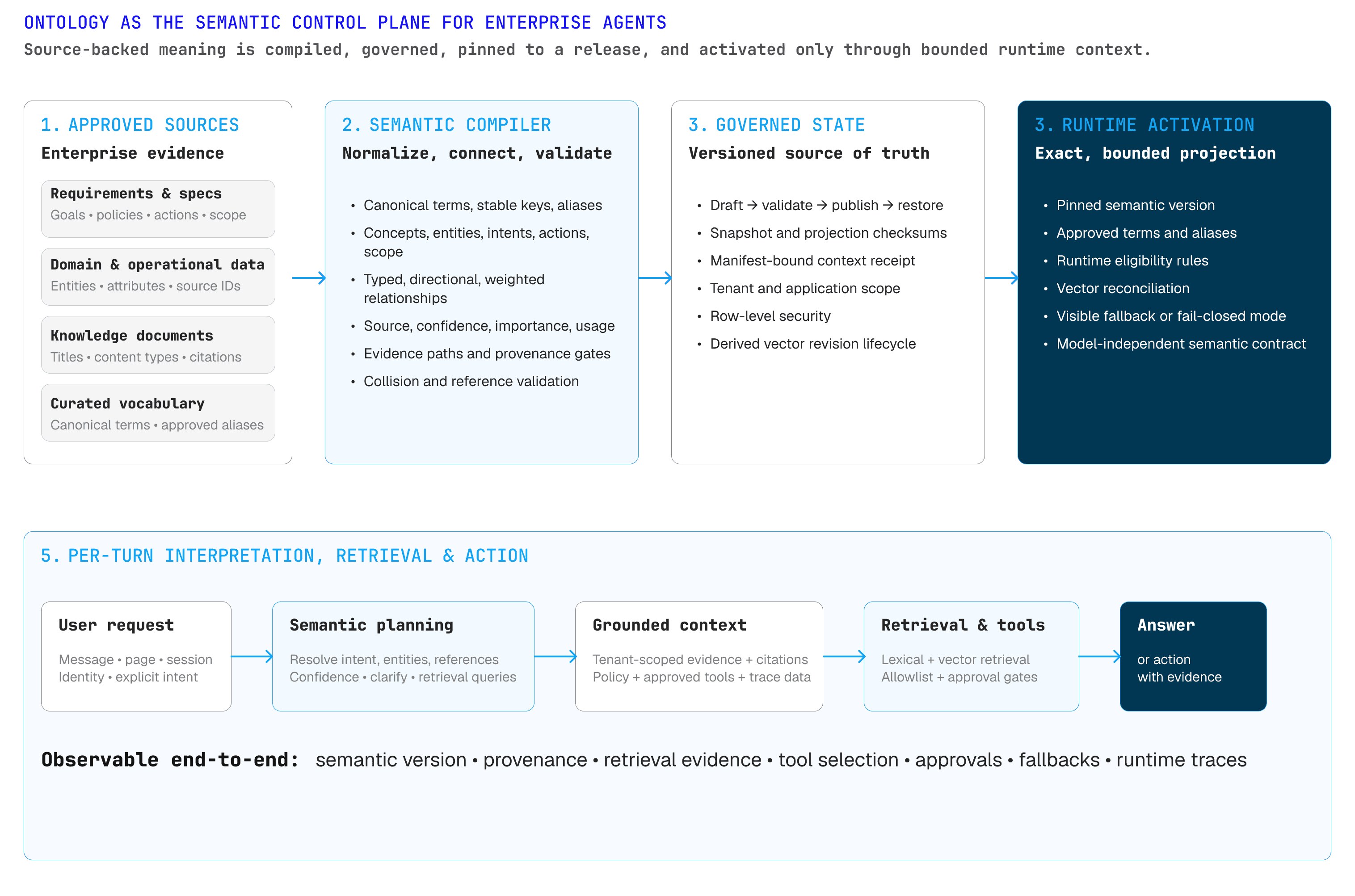
Soul of the Machine compiles approved enterprise sources into governed semantic state, then activates an exact, bounded projection for runtime interpretation, retrieval, and action.
The architecture has five connected layers.
1. Approved enterprise sources
Ontology generation begins with material the enterprise already recognizes as evidence: application requirements, domain specifications, product or operational data, knowledge documents, integration metadata, and manually curated vocabulary.
The platform can also use models to propose semantic candidates, but model output is enrichment, not authority. A proposed term must resolve to an approved source path before it can enter the compiled vocabulary. Candidates without evidence are discarded rather than quietly becoming enterprise truth.
This distinction matters. Generative models are excellent at discovering likely concepts and aliases, but an enterprise ontology must be grounded in the enterprise itself.
2. A provenance-aware ontology compiler
The compiler normalizes language, removes duplicates, assigns stable keys, groups concepts by semantic role, and captures canonical terms and aliases. It builds typed, directional, weighted relationships such as broader_than, maps_to_intent, maps_to_content_type, supports_action, describes, applies_to, and excluded_from_scope.
Every candidate carries metadata such as source, confidence, importance, status, usage, and provenance. Validation detects unresolved evidence, ambiguous aliases, invalid references, and other conditions that require review.
This creates a useful division of labor: models can accelerate discovery, deterministic rules enforce the contract, and people remain in control of what becomes active.
3. Governed, versioned semantic state
Compiled semantic context follows a controlled lifecycle: draft, validate, publish, retain history, and restore when needed. Each published state has deterministic checksums and an immutable runtime projection.
The runtime manifest records a semantic-context receipt that identifies the exact context version, snapshot checksum, projection checksum, and term count used by that release. In other words, an application release does not simply ask for “the latest ontology.” It can resolve the exact semantic state with which it was evaluated.
PostgreSQL remains the tenant- and application-scoped source of truth, protected by row-level security. Vector indexes are derived semantic accelerators with their own revision lifecycle. Before activation, the platform verifies that the vector revision reconciles with the sealed semantic projection.
That architecture gives enterprises something prompt-based systems rarely provide: reproducibility. When behavior changes, teams can determine whether the model, prompt, tool, retrieved evidence, or semantic context changed, and they can restore a known version.
4. Bounded runtime interpretation
At runtime, the platform exposes only the semantic objects eligible for operational use. Disabled terms, administrative-only concepts, and items without resolved provenance are excluded from the sealed projection.
The active semantic profile combines application goals, capabilities, approved tools, domain guidance, and a bounded set of terms and aliases. A semantic planning step can resolve references, classify intent, identify entities, propose retrieval queries, select candidate tool IDs, estimate confidence, or ask for clarification.
Critically, this planning layer is factuality-neutral. It can interpret the request, but it cannot invent the answer. Retrieval and approved tools remain the sources of factual authority.
This keeps ontology in its proper role: it guides meaning and selection without replacing source evidence.
5. Grounded retrieval, policy-bound action, and observability
The resolved request is assembled with tenant-scoped evidence, citations, active policy, and allowed tools. The platform can use lexical matching and vector retrieval together, while maintaining provenance back to source documents and operational systems.
Actions remain constrained by the deployed runtime manifest. Tools outside the allowed set cannot be invoked, and approval-gated actions remain blocked until valid approval is supplied. Runtime traces capture context loading, semantic planning, retrieval, tool selection, invocation, and response behavior.
Operators can also inspect ontology health directly: active and disabled terms, asserted relationships, disconnected concepts, unresolved provenance, and runtime-ineligible items. Asserted semantic relationships are distinguished from derived associations and presentation-only graph links, preventing an attractive visualization from being mistaken for semantic truth.
What enterprises gain from an ontology-first agent platform
Consistent behavior across agents and channels
A shared semantic context lets chat agents, voice agents, copilots, workflows, and generated applications interpret enterprise language consistently. The meaning of a “qualified lead,” “critical asset,” or “eligible return” does not have to be reimplemented in every prompt.
This consistency also improves multi-agent systems. Specialized agents can use different models and tools while coordinating through the same application vocabulary and concept boundaries.
Safer actions with less semantic drift
Agents often fail before the tool call itself: they choose the wrong entity, intent, or scope. Ontology reduces that failure surface by making semantic distinctions explicit and by excluding unresolved or non-operational concepts from runtime use.
Combined with tool allowlists, approvals, and policy checks, this creates defense in depth. The ontology helps the agent understand what the user means; runtime governance controls what the agent may do about it.
Better retrieval and more grounded answers
RAG quality depends on more than embedding similarity. Canonical terms, aliases, content types, named entities, intent mappings, and source provenance help the system form better retrieval queries and assemble more relevant context.
The result is not simply a larger prompt. It is a smaller, higher-signal context package tied to known sources and the current application state.
Faster adaptation as the business changes
Enterprises change vocabulary constantly. Products are renamed, policies are revised, new systems become authoritative, and acquisitions introduce overlapping terminology.
A versioned semantic layer localizes those changes. Teams can generate a draft, review differences, validate evidence, publish deliberately, evaluate runtime behavior, and roll back if needed. Updating meaning becomes a governed release process rather than a search through prompts and application code.
Auditability for regulated and high-consequence workflows
When an agent produces a recommendation or takes an action, enterprises need more than a transcript. They need to know which semantic version was active, which sources supported the interpretation, which tools were available, which policy applied, and where a fallback occurred.
Version receipts, provenance, tenant isolation, vector reconciliation, and runtime traces make that investigation possible. This is essential in healthcare, financial services, insurance, manufacturing, and any environment where a plausible answer is not enough.
Model and infrastructure portability
An ontology belongs to the enterprise, not to a model provider. By keeping semantic state separate from model calls and vector indexes, organizations can change models, retrieval engines, deployment clouds, and channels without recreating the business meaning layer from scratch.
That separation also improves evaluation. Teams can compare models against the same semantic contract instead of changing the model and its domain assumptions at the same time.
What to look for in an enterprise ontology system
Many products can draw a knowledge graph. Fewer can operate one safely as part of an agent runtime. Enterprise teams should ask:
Can every generated concept be traced to approved evidence?
Are asserted relationships separated from inferred associations and visual grouping?
Are semantic changes drafted, validated, versioned, and reversible?
Is the exact semantic version pinned to the application release?
Can runtime eligibility be controlled independently from authoring visibility?
Are vector indexes treated as derived infrastructure rather than the semantic source of truth?
Are ontology state, retrieval evidence, policies, and tool actions visible in one trace?
Is all semantic state isolated by tenant and application?
Can the system fail closed or fall back visibly when a projection is invalid?
These questions separate an ontology demo from an enterprise semantic control plane.
The next generation of agents will operate on shared meaning
The first generation of enterprise AI focused on giving models access to more information. The next challenge is giving agents a reliable understanding of what that information means, how it relates, and what actions are allowed.
That requires more than a longer context window. It requires a governed semantic layer that connects language to evidence, policy, and action.
Soul of the Machine’s Agent Platform makes that layer a first-class part of the application lifecycle: compiled from enterprise sources, reviewed by people, versioned like software, activated through exact runtime receipts, and observed in production.
The model can remain probabilistic. Enterprise meaning and authority cannot.
Soul of the Machine helps enterprises design and deploy agentic applications with the semantic foundations required for reliable action. Talk with us about building an ontology-driven agent platform for your organization.